
Marketing success is not just about creating campaigns. It is about understanding what works, what fails, and how to improve. This is where marketing plan evaluation becomes essential.
A strong evaluation process helps businesses measure marketing effectiveness, track marketing KPIs, and improve overall performance. Without proper evaluation, even the best strategies can fail due to lack of insight.
In this guide, you will learn how to evaluate a marketing plan, track performance metrics, and turn data into better decisions.
Understanding Marketing Plan Evaluation
Marketing plan evaluation is the process of analyzing your marketing strategies to determine their effectiveness. It helps you understand whether your goals are being achieved and whether your resources are being used wisely.
It includes:
- Reviewing marketing goals
- Measuring marketing performance
- Analyzing campaign results
- Identifying areas for improvement
Many people confuse evaluation with audit or analysis. Here is the difference:
- Marketing evaluation focuses on performance and results
- Marketing audit reviews the entire strategy
- Marketing analysis focuses on data interpretation
When done correctly, marketing plan evaluation helps businesses improve marketing ROI and make smarter decisions.
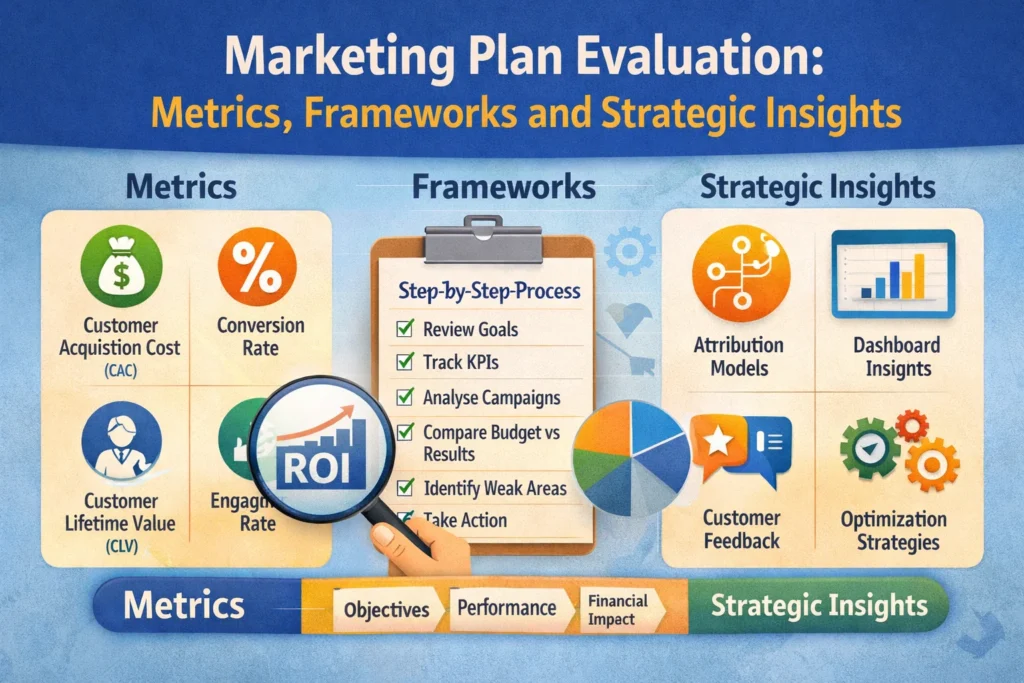
The Marketing Evaluation Framework
To properly evaluate marketing effectiveness, you need a structured approach. A simple framework can help you stay focused and organized.
🔹 Core Framework Components
| Element | Description |
| Objectives | Define clear marketing goals |
| Performance | Measure campaign results |
| Financial Impact | Analyze ROI and cost efficiency |
| Optimization | Improve future strategies |
This framework ensures that your marketing plan evaluation process is consistent and results driven.
Core Methods for Evaluating Marketing Effectiveness
To understand how to measure marketing effectiveness, you need both data and insights.
🔹 Quantitative Analysis
This method focuses on numbers and measurable results. It includes:
- Conversion rate
- Cost per lead
- Customer acquisition cost
- Revenue generated
- Website traffic
These metrics help you evaluate marketing performance and identify trends.
🔹 Qualitative Analysis
Many competitors ignore this, but it is just as important.
Qualitative analysis includes:
- Customer feedback
- Reviews and comments
- Brand perception
- User experience
This helps you understand why your marketing strategy is working or failing, not just what is happening.
Advanced Marketing Metrics That Matter
To perform a strong marketing plan evaluation, you need to track the right metrics.
🔹 Key Marketing KPIs
- Customer Acquisition Cost (CAC)
- Customer Lifetime Value (CLV)
- Conversion rate
- Engagement rate
- Lead generation performance
These metrics help you evaluate marketing strategy performance and improve results.
Example:
If your CAC is high and CLV is low, your strategy is not sustainable.
Tracking these KPIs helps you:
- Improve marketing ROI
- Reduce wasted budget
- Increase profitability
Marketing Attribution: What Drives Results
Many businesses struggle to understand which channel brings results. This is where attribution helps.
Attribution answers:
- Which campaign generated leads
- Which channel drove conversions
- Where to invest more budget
🔹 Types of Attribution Models
- First touch attribution
- Last touch attribution
- Multi touch attribution
Using attribution improves your marketing performance evaluation methods and helps you make better decisions.
Building a Marketing Performance Dashboard
A dashboard helps you track all your marketing metrics in one place.
🔹 What to Include
- Traffic data
- Conversion rates
- Campaign performance
- ROI tracking
- Lead data
A good dashboard makes your marketing plan evaluation process faster and more accurate.
🔹 Benefits
- Easy tracking
- Better decision making
- Real time insights
Step by Step Marketing Plan Evaluation Process
If you are wondering how to evaluate a marketing plan step by step, follow this simple process.
🔹 Step 1: Review Marketing Goals
Make sure your goals are clear and measurable.
🔹 Step 2: Track Marketing KPIs
Focus on key metrics like conversion rate and ROI.
🔹 Step 3: Analyze Campaign Performance
Check which campaigns are working and which are not.
🔹 Step 4: Compare Budget vs Results
Evaluate cost effectiveness.
🔹 Step 5: Identify Weak Areas
Look for gaps and improvement opportunities.
🔹 Step 6: Take Action
Optimize your strategy based on insights.
This step by step approach ensures effective marketing plan evaluation and better results.
Marketing Plan Evaluation Template (Scoring Model)
To make evaluation easier, you can use a scoring system.
Example Scorecard
| Criteria | Score (Out of 20) |
| Goal Clarity | 15 |
| KPI Tracking | 18 |
| ROI Performance | 12 |
| Channel Effectiveness | 16 |
| Optimization Strategy | 14 |
Total Score: 75 out of 100
This marketing plan evaluation template helps you quickly assess performance and identify areas for improvement.
Industry Specific Evaluation Approaches
Different industries require different evaluation methods.
🔹 SaaS Businesses
- Focus on CAC and CLV
- Track subscription growth
🔹 E commerce
- Focus on conversion rates
- Analyze customer behavior
🔹 Local Businesses
- Focus on leads and foot traffic
- Track local engagement
Customizing your marketing plan evaluation based on industry improves accuracy.
How to Identify Underperforming Campaigns
Not all campaigns succeed. Identifying weak campaigns is key.
🔹 Warning Signs
- Low conversion rates
- High cost per lead
- Low engagement
- Poor ROI
🔹 How to Fix
- Improve targeting
- Adjust messaging
- Test new channels
- Optimize budget
This helps improve marketing performance and ensures better results.
Turning Evaluation into Continuous Growth
Evaluation is not a one time task. It should be continuous.
🔹 Growth Strategies
- Regular performance tracking
- Continuous testing
- Data driven decisions
- Strategy updates
By repeating the marketing plan evaluation process, businesses can achieve long term success.
Future Trends in Marketing Plan Evaluation
Marketing is evolving, and evaluation methods are changing.
🔹 Key Trends
- AI driven analytics
- Predictive data analysis
- Automation tools
- Advanced dashboards
These trends make marketing plan evaluation faster and more accurate.
Conclusion: From Data to Better Decisions
Marketing plan evaluation is not just about reviewing results — it’s about improving future performance. By using the right metrics, frameworks, and tools, you can:
- Measure marketing effectiveness
- Improve marketing ROI
- Optimize campaigns
- Achieve better business results
If you want long-term success, start evaluating your marketing strategy today to drive smarter decisions and sustained growth.
Frequently Asked Questions
Q1. What is marketing plan evaluation?
Marketing plan evaluation is the process of analyzing marketing strategies and campaigns to measure their effectiveness. It helps businesses determine whether their marketing goals are being achieved and identify areas that need improvement.
Q2. What metrics are used in marketing plan evaluation?
Common metrics used in marketing plan evaluation include conversion rate, customer acquisition cost (CAC), customer lifetime value (CLV), engagement rate, lead generation performance, and return on investment (ROI). These metrics help measure marketing performance and efficiency.
Q3. How often should a marketing plan be evaluated?
A marketing plan should be evaluated regularly, typically on a monthly or quarterly basis. Continuous evaluation helps businesses track campaign performance, adjust strategies, and improve overall marketing results.
Q4. How can businesses improve their marketing plan evaluation process?
Businesses can improve marketing plan evaluation by tracking the right KPIs, using marketing dashboards, analyzing both quantitative and qualitative data, and regularly optimizing campaigns based on performance insights.